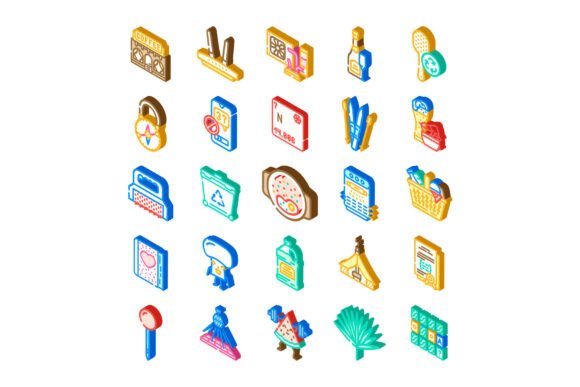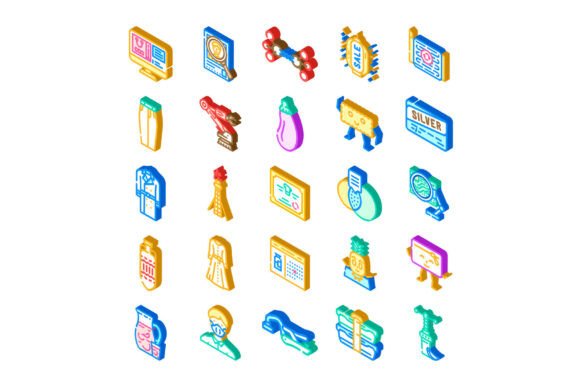
Isometric Elements Collection Representi
The Isometric Elements Collection Representi is a curated set of scalable, vector-based isometric illustrations designed to depict everyday objects, technology components, food items, and abstract concepts—such as growth, connection, security, or efficiency. Unlike generic clipart or stylized icon sets, this collection emphasizes consistent perspective (30° angles), uniform lighting, and harmonized color palettes, enabling seamless integration across visual projects.
It is not a single illustration or a monolithic template, but rather a modular library: individual elements can be combined, recolored, resized, or rearranged without visual dissonance. The collection targets designers, data communicators, product teams, and educators who require clarity, scalability, and stylistic coherence in diagrams, dashboards, presentations, and digital interfaces.
Why Consider This Collection?
Designers often face recurring challenges when building visuals that communicate function, process, or context. Flat icons lack spatial relationships; photographs introduce realism that competes with conceptual messaging; custom-drawn assets demand time and stylistic consistency. The Isometric Elements Collection Representi addresses these gaps by offering ready-to-use, perspective-accurate components grounded in real-world referents—yet abstracted enough for conceptual use.
For example, a project manager illustrating a cloud migration workflow might combine isometric servers, network nodes, and data arrows from the collection—each sharing the same vanishing point and shadow logic. A nutrition educator could assemble isometric fruits, utensils, and portion plates into an accessible meal-planning infographic. In both cases, the collection reduces cognitive load for viewers by preserving intuitive spatial cues while avoiding photographic clutter.
Practical Benefits and Realistic Tradeoffs
Benefits include:
- Time efficiency: Pre-built, aligned elements eliminate the need to construct isometric grids or adjust perspective manually.
- Visual scalability: Vector format ensures crisp rendering at any size—from mobile UIs to large-format prints.
- Thematic range: Coverage spans tangible (e.g., coffee mugs, smartphones, bicycles) and intangible ideas (e.g., “trust,” “feedback loop,” “scalability”) through symbolic yet recognizable forms.
- Customization flexibility: Elements are typically provided in layered, editable formats (e.g., SVG or AI), supporting color adjustments, grouping, and selective visibility.
Tradeoffs and considerations:
- Limited stylistic variation: The collection prioritizes consistency over diversity. Users seeking hand-drawn, minimalist, or ultra-realistic aesthetics may find its mid-tone, clean-lined approach too uniform.
- No built-in animation or interactivity: While static elements integrate well into animated prototypes or web graphics, motion must be added externally—no native Lottie or CSS-ready variants are included.
- Learning curve for composition: Effective use requires understanding isometric logic—e.g., how to layer objects without violating depth hierarchy or misaligning axes. Beginners may need reference guides or practice to avoid spatial inconsistencies.
- Licensing scope matters: Usage rights vary by license tier. Commercial redistribution (e.g., embedding in a SaaS dashboard sold to clients) may require extended licensing—not always obvious from surface-level documentation.
When It’s a Strong Fit
The Isometric Elements Collection Representi excels in contexts where clarity, scalability, and conceptual fidelity outweigh stylistic novelty. It is particularly well-suited for:
- Infographics and data storytelling: When explaining systems, workflows, or comparisons—especially where relative scale or physical arrangement supports comprehension (e.g., showing server racks alongside user devices in a cybersecurity overview).
- Product onboarding and feature explanations: Illustrating how software interacts with hardware, or how a service connects users, tools, and outcomes—without relying on screenshots that date quickly.
- Educational materials: Teaching spatial reasoning, design fundamentals, or STEM concepts where isometric representation reinforces dimensional understanding (e.g., anatomy models, engineering assemblies, or molecular structures).
- Brand-aligned internal documentation: Teams maintaining design systems benefit from reusable, on-brand visual vocabulary—especially if their brand guidelines already embrace geometric simplicity and structured layouts.
When Alternatives May Be More Appropriate
This collection is less ideal in scenarios demanding high stylistic specificity or contextual nuance. Consider alternatives if:
- You need culturally or regionally specific representations: For instance, food items depicted reflect broad Western conventions (e.g., baguettes, laptops, office chairs); localized variants (e.g., rice bowls, tuk-tuks, traditional textiles) may require supplemental illustration or custom work.
- Your project relies heavily on emotion or narrative tone: Isometric visuals prioritize structure over expression. A story-driven campaign highlighting human experience may benefit more from illustrated characters, expressive typography, or photography.
- You’re working under tight constraints for file size or performance: While vector files are compact, complex compositions with many grouped layers can increase SVG payload. For highly optimized web delivery—especially on low-bandwidth platforms—lightweight icon fonts or inline SVG sprites may offer better control.
- You require strict accessibility compliance beyond visual design: The collection provides visual elements but does not include semantic markup, ARIA labels, or contrast-tested color variants. Integrating it into accessible interfaces requires additional development effort.
Making a Practical Decision
Evaluating whether the Isometric Elements Collection Representi aligns with your needs starts with clarifying your primary goal. Ask yourself:
- What problem am I solving visually? If it’s about clarifying relationships, processes, or spatial logic—not evoking mood or identity—the collection’s strengths align well.
- What’s my production capacity? If you have limited illustration resources but need consistent, professional-grade visuals quickly, its modularity offers tangible efficiency gains.
- How long will this visual language remain relevant? Isometric style has enduring utility in technical and explanatory contexts, but avoid overcommitting if your brand strategy anticipates frequent aesthetic shifts.
- Do I control the final output environment? Since the collection delivers source files—not hosted assets—you retain full control over optimization, localization, and updates. That’s valuable for long-term maintenance but requires basic vector editing familiarity.
In summary, the Isometric Elements Collection Representi is a practical tool—not a universal solution. Its value emerges most clearly when matched to specific communication goals: explaining structure, mapping systems, or bridging abstract ideas with tangible form. Success depends less on acquiring the collection and more on understanding how its constraints and affordances serve your audience’s need for clarity—and your team’s need for reliability.